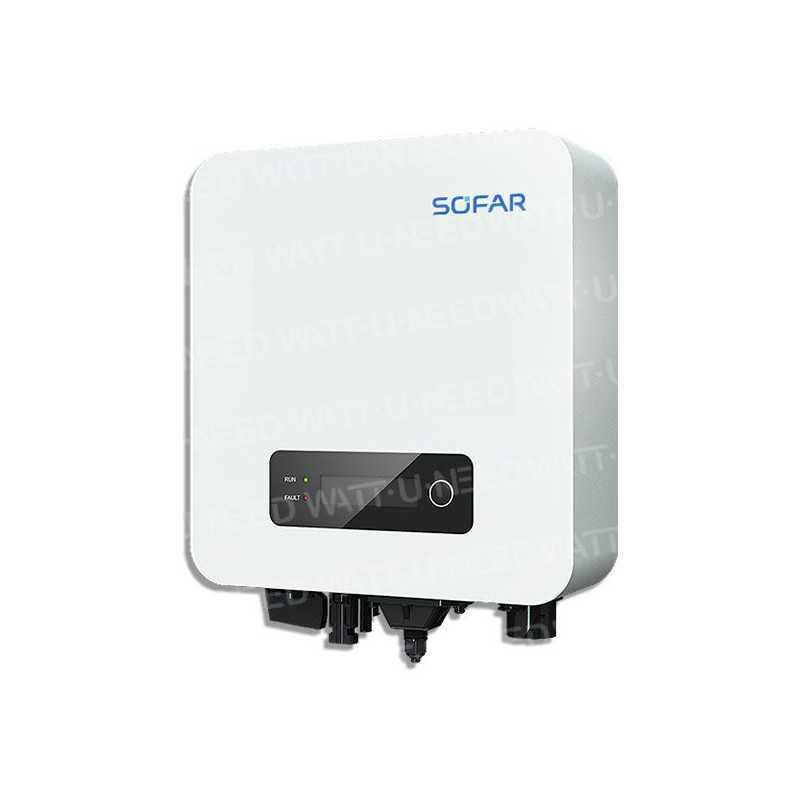
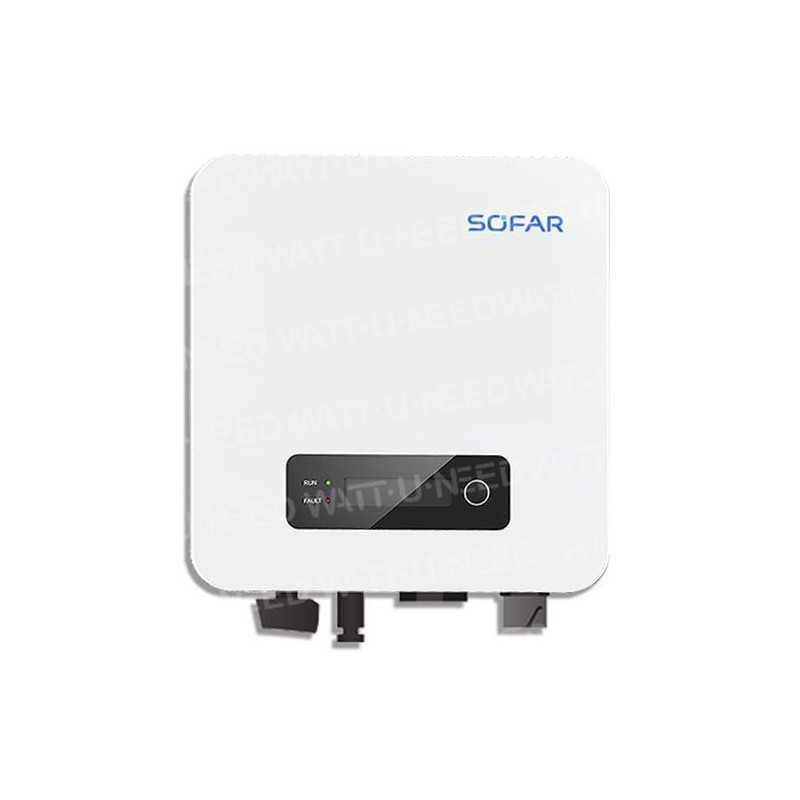
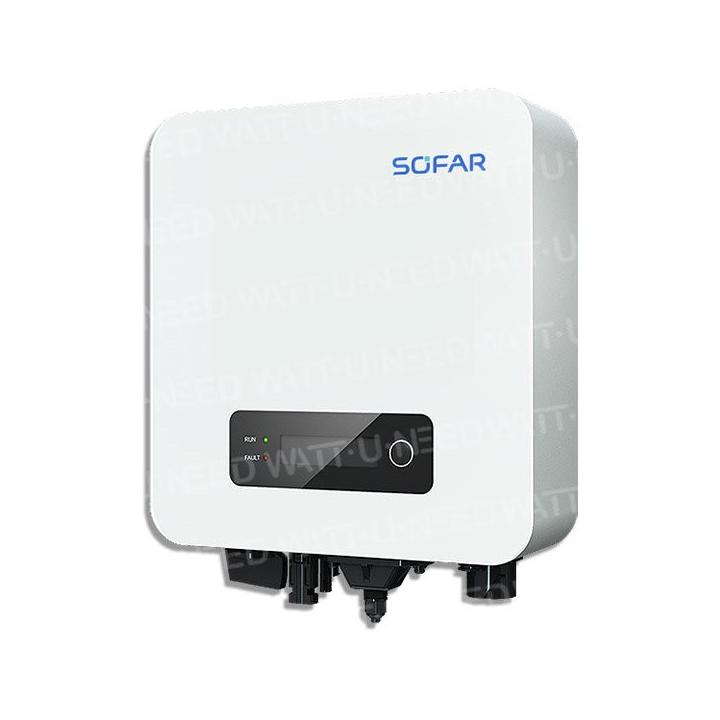
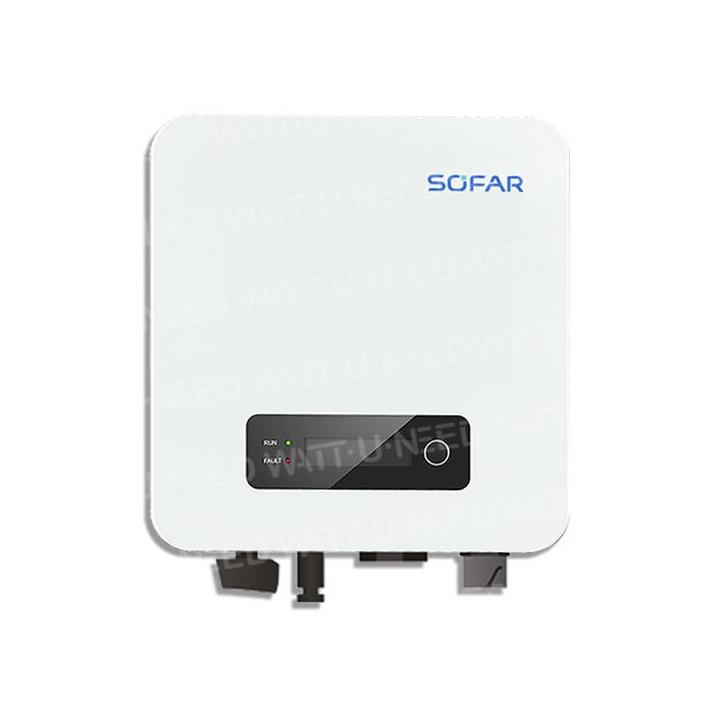
The Sofar Solar 1600TL-G3 is a compact 1, 600 W single-phase grid-connected inverter designed for small grid-connected photovoltaic systems. Lightweight (5.5 kg), fanless and supplied with a Wi-Fi dongle, it offers a turnkey solution for self-consumption or grid feed-in on small residential roofs, garden sheds, conservatories or small-scale agricultural installations requiring slightly more power than the 1100TL-G3 model.
The SofarSolar 1.1K...3.3KTL-G3 is a sleek, compact and lightweight solar inverter for the smallest single-phase PV systems.
With an efficiency of up to 97.7%, it maximises the energy yield of your photovoltaic system. The built-in zero export function allows the user to limit the power fed into the grid by simply adding a current transformer to the system.
The inverter also comes with a WiFi dongle, allowing you to easily connect the inverter to the SofarSolar monitoring portal.
• Maximum efficiency of 97.5%.
• Precise real-time MPPT algorithm for maximum output
• Wide input voltage operating range
• Flexible installation options thanks to IP65 rating
• Easy installation and maintenance thanks to the ‘Plug & Play’ connection
• Choice of interface – Wi-Fi / RS485 / GPRS
• LCD + LED display
• Integrated zero export function (optional)
• Removable cover for easy installation
• Stainless steel covers
• A flexible control solution
• Reactive power capacity
• Automatic power reduction in the event of over-frequency
• Remote control of active/reactive power limits
A. Energy management unit
This control can be used to switch the inverter on/off via an external (remote) control.
B. Reactive power supply to the grid
The inverter is capable of generating reactive power and can therefore feed it into the grid by adjusting the phase angle. The feed-in management can be controlled directly by the grid operator via a dedicated RS485 serial interface.
C. Limiting the active power fed into the grid
If enabled, the inverter can limit the amount of active power fed into the grid by the inverter to the desired value (expressed as a percentage).
D. Automatic power reduction when the grid is over-frequency
When the grid frequency exceeds the limit value, the inverter reduces the output power, which is necessary for grid stability.
E. Data transmission
The inverter or a group of inverters can be monitored remotely via an advanced communication system based on the RS-485 serial interface, or remotely via Wi-Fi/GPRS.
F. Software updates
Support for local software updates via USB stick and remote updates via Wi-Fi/GPRS.
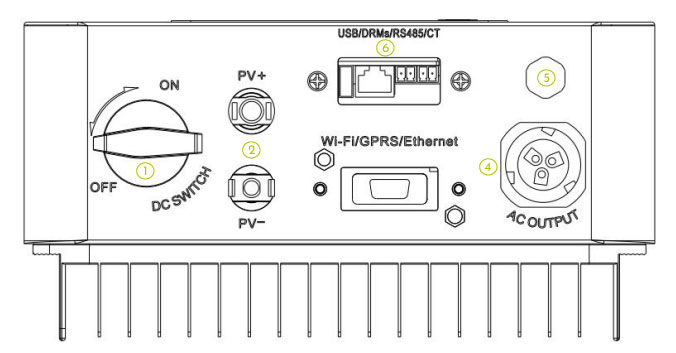
1. DC switch
2. PV input terminals
3. Wi-Fi/GPRS/Ethernet
4. Network connection port
5. Bleed valve
6. USB/DRMs/RS485/CT

Sofar Solar Mono 1.6 kW Grid Inverter – 1600TL-G3 by Sofar Solar is available in our Inverters and converters catalog. Technical specifications: inverter power in va: 1600 VA, operating temperature: -30℃ – 60℃, phase: Monophasé, number of mppt: 1 MPPT, ip protection: IP65 , inverter type: Grid, max. recommended pv input power: 2200 Wc, max. input current: 12 A, starting voltage: 70 V, nominal mains voltage: L / N / PE, 230 Vac, rated mains frequency: 50/60 Hz, emc: EN 61000-6-1, EN 61000-6-3, EN 61000-3-2, EN 61000-3-3, type of cooling: Natural convection, standard warranty (years): 10 years, humidity: 0 à 100 %, thdi (nominal power) : inférieur à 3 %, weight: 5,5 kg, dimensions (l x w x d) : 303 x 260,5 x 118 mm, maximum input voltage: 500 V, communication: RS485 / WiFi, optional: Ethernet, power factor: 1 par défaut (+/- 0,8 réglable), max. output current: 7,7 A, anti-islanding protection: Oui, assembly: Montage mural, noise: inférieur 25 dBA, display: LCD + LED display, nominal input voltage: 360 V, maximum efficiency: 97,5 %, rated ac power: 1600 W, protection against reversed dc polarity: Oui, maximum dc short-circuit current: 15 A, mppt operating voltage range: 50 - 500 V, safety standards: IEC 62116, IEC 61727, IEC 61683, IEC 60068 (1, 2, 14, 30), IEC 62109-1 / 2, network standards: VDE V 0124-100, VDE V 0126-1-1, VDE-AR-N 4105, G83 / 2, C10 / 11, RD 1699. Product weight: 5.5 kg. Reference: Sofar-1600TL-G3.
check_circle
check_circle